
I wrote the piece below as an update for the existing and regular donors to Nirvanvan Foundation in July 2025:
July 2025
Hello! My name is Clare Raido and also Satya Roopa. I have recently returned from India and my visit with Nirvan at the Nirvanavan Foundation. I have just today been in communication with him about the tiger pugmarks at Shyam shah confirmed by an expert as a sub-adult female tiger. Nirvan is up at Shyam shah right now making a plan for tree planting.
Okay, so who am I and where did I come from?
My work is an integral part of my life; it is my life. Professionally speaking I have been practising the person-centred approach for many years, first as a dental surgeon and then since 1999 as a psychotherapist. I also supervise and train therapists. ‘Who am I?’ and ‘What am I doing here?’ have been my motivating questions. I have studied many theories, practices and disciplines, for examples: systems theory, ecopsychology, permaculture, shamanic practice, Wild Therapy, Embodied- Relational Therapy, human development, affective neuroscience and developmental psychology. Practising as a (person-centred) therapist means being present and aware with someone else and in this way it is, for me, a spiritual practice. Life is my teacher. Interested in energy and awareness, I took a course on Prana Vidya over three years ago and did not look back. I met some yogis with whom I felt a strong connection and when the opportunity arose to join them in India at the Nirvanavan Foundation, and at the invitation of Nirvan, there was no question that I would go and visit. I had spent 6 months in India in 1983/4 as an 18 year old working at Vellore Christian Medical Hospital in the maternity wards and also working on an education programme in relation to Leprosy and I knew that one day I would return when the time was right. This was that time. I had little idea what I would meet at the Nirvanavan Foundation. I was captivated by what I found and I interviewed Nirvan for 4 days to understand all his projects and their interrelatedness. Everything that I have discovered about life and how to work with life – in harmony with it, in love of it, in trust of it – was here. I am still blown away by the freedom of vision and the level of connectivity at work there, together with the loving and realistic engagement with all the living beings in and around that place; I knew I would support Nirvan and the work of the Foundation in any way that I could.
What I saw:
Projects serving the community – people, land, plants animals:
Nirvan and I have an interest in Permaculture in common: that is working with natural systems – seeing what needs to be done and doing it – working with what you have and supporting the connections available to you – staying open to possibilities – channelling energy efficiently – what is going on in this place? How can we work with and support life here?
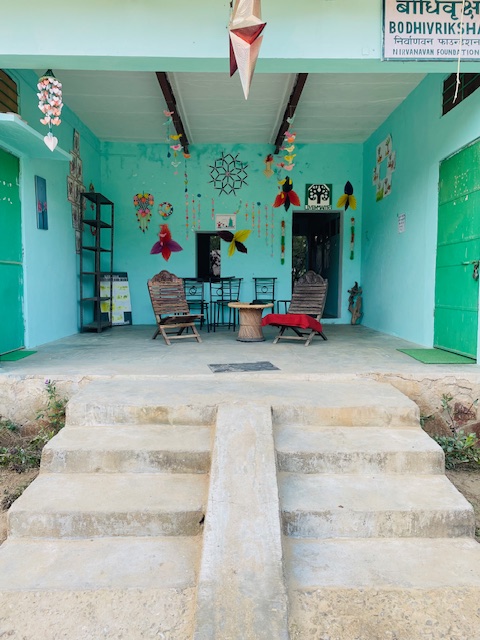
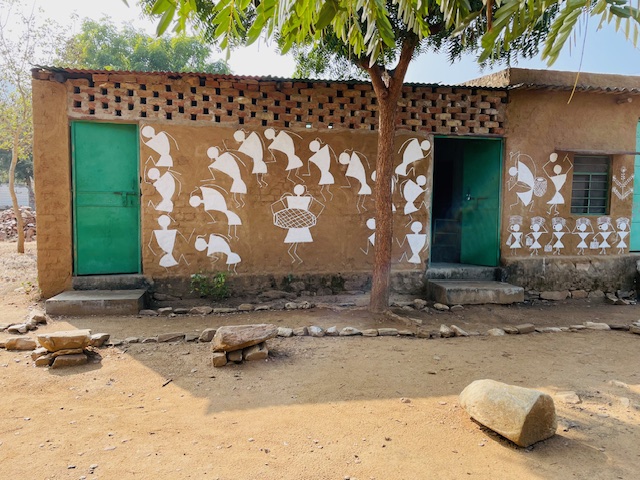
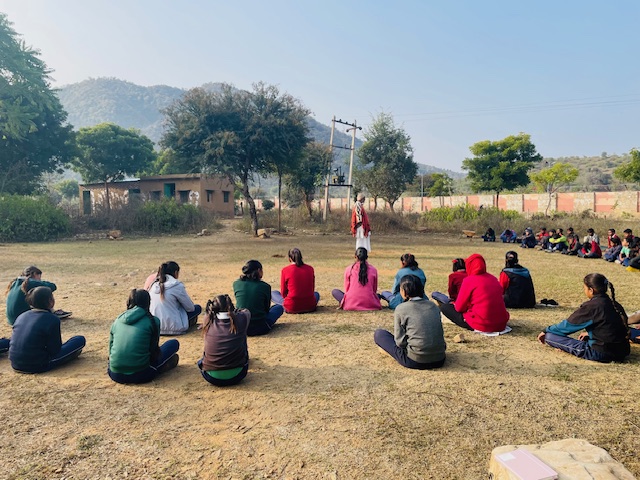
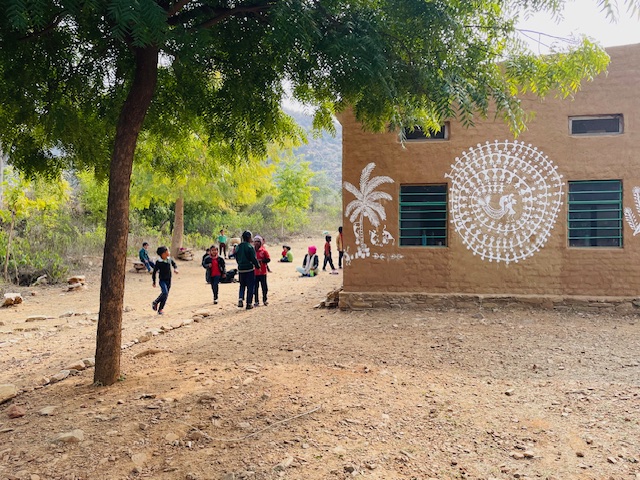
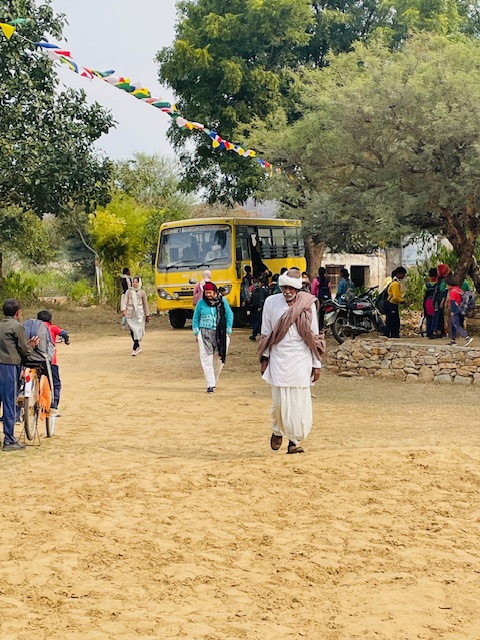
Schools: I witnessed around 200-300 children arriving every day and they looked and sounded like they were happy being there. I took part in the morning meditations, for example walking the circle with bare feet practising awareness and acceptance and being with feelings and sensations. I understand there were 10 community based schools but most are dormant due to lack of funding. Right now and for a while it has been difficult to pay the teachers. The school head quarters at Advaita Garden was undergoing some building work after some funding had come in to create more classrooms which can also be used as accommodation possibilities for residential gatherings. I understand that the school here follows a government-based programme but also include things government schools do not, for examples: art projects, games and sport activities and meditation practice. While I was there a travelling theatre company came and performed for the children much to their fascination and delight. I also watched the girls playing hockey with skill and enthusiasm. When talking to the children and young people, I found them open, confident, curious and playful. I understand that the school is not just a school – there is a whole support system in place for the children and families of those children. In the holidays the teachers go and work in the villages and check on the children and talk to the parents. I met the headmaster and school administrator. The children come for help with anything and everything from needing a new pencil, to help to mediate a family dispute, to sourcing a fridge because they are getting married. Nirvan is involved with the whole community as counsellor, mediator, educator, and creative help with any problem.
Community Schools and peace project: I did not visit any other school sites. There is lots to say about the education programme and too much for the purpose of this update, but hearing about the way the education project has evolved and how it is linked with the peace project is fascinating and inspiring. Getting these projects up and running again would seem extremely worthwhile. This would be possible if funding could be reestablished in this post COVID period.
Toilets: Some workers from an NGO that provides toilets and sanitation in public places came to visit Advaita Garden while I was there – they wanted to see the gas system which is fuelled by the cow dung. This large charity works all over India, Kenya and Ethiopia. One of Nirvan’s ex-pupils is a leader of the charity – they will fund a toilet block for the new school building.
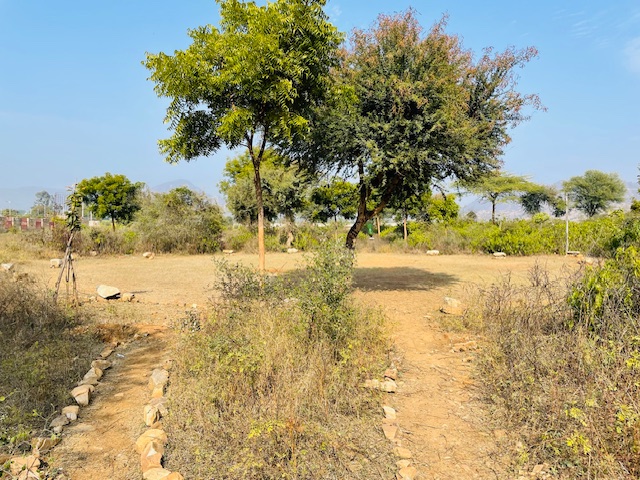
Tree planting and forestation: I saw plants and trees growing in the nursery; these plants have been growing from seed. There is an ongoing programme of collection of native seeds, growing plants and planting native trees and medicinal plants. The method of creating forest is inspired by the Japanese botonist Akira Miyawaki. Also leaves are collected and turn into leaf mould also for soil conditioning.
Cow dung collection and gas production from dung slurry: which is used for all the cooking using gas burners. The slurry is also used as manure. The conditioning of the soil and the tree planting is one whole process.
Water management systems: Mostly it is very hot here and water is precious. I saw irrigation and water collection and storage systems at work and being developed – there is a plan for some concrete water storage tanks. I learned about the making of ponds and dams, both at Advaita Garden and throughout the whole valley. Advaita Garden is self-sufficient in water. Nirvan has a plan for water storage to feed the school. Following water shortage in the valley there is now plenty of water in the valley because of a collaboration between Nirvan and one of his ex-pupils who became mayor in that region. They set about making areas for the collection of water and infrastructure that supplies the aquifers underground.
Solar power: The whole of Advaita Garden in self-sufficient in electricity. All electricity comes from solar power and photovoltaics. Solar generated power is collected in batteries for the grinding of wheat. Electricity supplies lighting, water pump, heating water, water coolers, air conditioning and plug sockets.
Hydroponics: Some infrastructure is present but there is no one who knows how to use it. Expertise is needed to use the materials at hand to make the right nutrition/mineral mix for the plants. If this could be set up NF could be self-sufficient in vegetables. This is an interesting and worthwhilepermaculture volunteer project waiting to happen – we just need to connect to the Permaculture Association and get some word out through the magazine and the website about this volunteer project. Action has been taken on this; I have contacted the CEO of the Permaculture Association in the UK and he is keen to talk more and I will write an article about NF for the magazine and think with them about a blog on the website to give information and stimulate interest from volunteers. This could be an access point for volunteers from the UK. It is also possible that permaculture training course could happen at NF with local and international participants. Possible. Yoga Bijananda can take some similar action in Germany to connect with ecological activists there. We can communicate about this.
Ecological activism: The whole place is a site of living ecological activism and it is a meeting place for activists; just before I arrived there had been a residential gathering of ecological activists at Advaita Garden.
Community/cultural activities: the yearly wrestling tournament took place at Advaita Garden just before I arrived. There is a special circle built for this purpose. The stage is regularly used for plays and festivals: Waiting for Godot by Samuel Beckett was performed there recently.
The slum boys cricket tournament for communal harmony and peace: nearly was cancelled but the event was rescued by some last minute funding from Germany and UK. This is for the children from urban slums in Alwar city. The tournament is designed for the volunteers from the slums who make a system to reach children in need of help and rescue. This volunteer system still functions even though Childline has been taken over by the government. If Nirvan had two people working with him on child related issues he could get this system up and running again in support of the government child line. There is even more potential for helping children in Alwar through outreach at the 200 Melas that take place in the Alwar district.
Cows: There is goshala (cow stable bock) with 40 abandoned cows that the Foundation has taken in and are looking after. While I was there, two cows died from eating bad food put out by the temple after a bandhara. Another cow was taken by the leopard after falling down a cliff.
Food work: Feeding people in the hospital in Alwar: After Childline was taken over by the Government Nirvan initiated another project to feed people. He targeted the hospital as a suitable place for this project as people in the hospital there are poor; they might have needed to travel a long way to the hospital and the families cannot feed them as it is too far away from their homes. The hospital project provides two meals a day for patients in the hospital. The hospital itself treats but does not feed people. The initial funding source allowed for 200-300 plates per day to be delivered. This has come down to 50 plates per day from the original funders. NF is looking for donors who can support this project with food donation or financial donation. Currently 100 plates per day are served with edible oil, rice and daal being donated locally. I went to the kitchen and office of this project and met the people who administer it. There is an autorickshaw which is used for meal delivery.
Work with women for their empowerment: The education work with the sex workers has stopped since COVID due to lack of funding. Nirvan employs women and did run education programmes as well as meeting the consequences of educating those women.
Cremation Ground: There are plans to build a platform for the building of a pyre. 1 cremation has taken place here already. Deaths will happen so a place is needed to do what needs to be done when someone dies.
People: There is a core group of people at NF who enable the place to keep running. There are challenges all the time to sustain activities due to events in the lives of the people who are there and sustaining the basic incomes. There is lots of room for volunteerism and exchange. There are many opportunities for people to contribute and learn and share and take part in the life of NF. Opportunities are available to people in India and for people to come from other countries for learning and exchange. Nirvan can support and enable different projects to happen if the energy in the form of interested people wanting to bring skills, funding and donation arrives.
Website: Krishnadhyanam has welcomed input from Russell Smithers who is a computer expert and yoga teacher – he is happy to help get the website up and running again so that people who are interested to find out more about NF can do so and donate to Towards Nirvana if they wish. I am keen to get this up and running as soon as possible so that the increased interest that I anticipate coming from talking to people and writing for the Permaculture Association here in the UK as well as activity in Germany can be directed with confidence to the website and charity pages online.
So, I hope this gives you a flavour of the current life of the Nirvanavan Foundation. There are things happening and much more potential ready to be fulfilled if funding streams could be regenerated as well as more people putting their energy towards Nirvana. I think many people would want to do this – we just need to let them know and give them an opportunity to be involved. I would love to return to Nirvanavan Foundation and there is potential for me to run some sort of programme there for therapists which would fulfil functions of learning and exchange as well as income generation for Nirvanavan Foundation.
Best wishes
Clare Raido/Satya Roopa
 Clare Raido